Distribution: 產地: | Mainly produced in Shanxi, heilongjiang provinces and Inner Mongolia Autonomous Region, also produce in jilin, Gansu, hebei, Shaanxi and northeastern part of China. 主產於山西,黑龍江, 內蒙。吉林,甘肅,陜西,東北亦有生產。 |
Actions & Indications: 主治 : | In qixu (qi deficient) , pixu (spleen deficient) and yangxu (yang deficient), weakness and fatigue, numbness of limb, morbidity after stroke, sweating, promoting pus discharge and tissue regeneration. Promotes diuresis to reduce edema. Treatment of diabetes. Treatment of xinyangxu (heart yang deficient) and shenyangxu. 用於氣 虛, 脾虛,陽 虛,心 陽虛, 腎陽虛,體 弱疲倦,肢體麻木,中風後遺癥,自汗,糖尿病。可幫助排膿,生肌。利尿消腫。 |
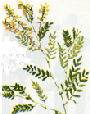
Chemical ingredients: 化學成分: | 1. Astralagus menbranaceus, (Fisch.) Beg. astragaloside I, astragaloside II, daucosterol, beta-sitosterol, palmitic acid, sucrose [1]. Astragalus saponin A,B,C. Astramenbrangenin was obtained after oxidization of astralagus menbranaceus saponinby Smith. [2]. 2',4'-dihydroxy-5, 6-dimethoxyisof lavane, kumatakenin, choline, betaine, folic acid [3,4], calyxosin, formononetin, cycloastragenol, astragaloside I,II,III,IV [5], and antibacterial ingredient, L-3-hydroxy-9-methoxpterocarpan[6]. 2. Astragalus mongholicus (Beg) Hsiao (more to upload) |
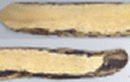
Quality: 質量: | Usually the smaller pieces are better than the large, wider pieces. The larger pieces can be either reconstituted from the little pieces or made from the smaller roots that has been soaked in water and mechanically pressed into wider pieces. In the process, the effective ingredients may leach out into the water. The wild roots are the best. Usually the wild roots are not as large and the fibers are more distinctive 一般較小片比寬大片較好。較大片的可能是用小片壓成的,或用較小的根浸泡在水中,浸軟後,用機器壓成的。在 這個過程中,有效成分可能浸出到水中。
野生的根是最好的。通常情況下,野生的根一般是不很大,而且纖維明顯。 |
Cautions and Contra-indications: 禁忌: | There are many varieties of astragalus. Some are toxic. The varieties used in Chinese herbal medicine is relatively safe but in rare cases it might cause skin rash, especially in patients with pixu (spleen deficient) and serious shenyangxu (kidney yang deficient) conditions. It cannot be used in liver yang ascending type of hypertension but can be use in qi deficient and blood deficient type of hypertension. Huang qi is a strong tonic and can raise the function of the body, thus it is not suitable to use in acute infections, like cold or flu, boils, skin ulcers, yin deficient with fever, digestive tract infection.不能用於 肝陽上亢所引起的高血壓。但可以用於氣 虛與血虛型 的血壓高。 而由於黃耆溫補升陽之力甚強。不宜用於是表實邪盛、熱毒瘡瘍、 陰虛身熱、積滯痞滿 、肝陽上亢者。黃芪有多種。有些有毒 。 中藥用的種類是相當安全的,但在很少情形下曾有發生皮疹, 尤其是 脾 虛與 腎陽虛患 者。 |